
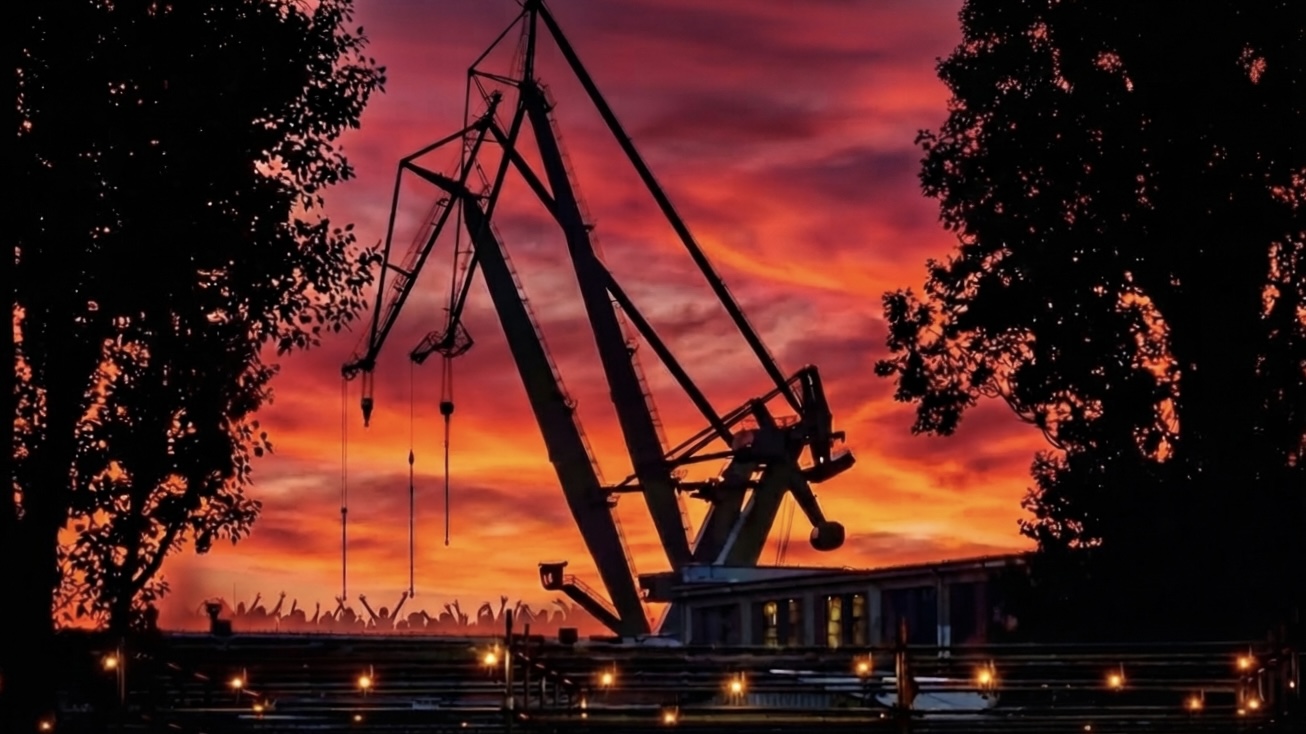
When I found out that Mystic Festival was changing location, and that this would be its final edition at that brilliant venue, the Gdańsk Shipyard, I decided I had to make the trip and soak up that atmosphere one last time — most likely for good.
Just organizing the trip — packing up the family, fixing the car at the last possible moment, and closing out work deadlines right before heading to Gdańsk — was its own kind of logistical, brutal death metal. Unfortunately, despite my original plan to arrive earlier, I’d known for a while that Warm-Up Day would only get me there in spirit. The acts I cared about most were a reactivated Damnation and Swedish legends Grave and Unleashed, who actually drew mixed reviews in the end — so I didn’t feel too cut up about missing them (especially since I’d already „ticked off” those bands long ago). I also missed Danish act Neckbreakker, who come across rather promisingly on record. Grave apparently fell victim to disastrous sound on the Desert Stage, and Unleashed weren’t quite clicking sonically either.
My actual Mystic Festival 2026 adventure began on Thursday, when — after two hours of sleep, an exhausting drive, a quick hello to the Bay of Gdańsk on the beach at Stegna, checking into the apartment, and a rushed walk through the city — I finally crossed the rusty gates of the Shipyard.
Thursday: From Indian Sunshine to Cosmic Trance
I kicked off the festival with Bloodywood on the Park Stage, and I have to admit the Indians brought a dose of pure positive energy. Traditional instrumentation combined with a modern approach to songwriting made me stop and linger for a good while. Two vocalists, hugely energetic and impeccably mixed, with some genuinely original sounds thanks to the local flavor — but also plenty of clean, almost pop-leaning vocal sections, which might hint at serious commercial success for this band (if they haven’t already achieved it). I hadn’t known them before; not really my thing, but during the set I did remember someone showing me this band once.
During this set I was scouting for my buddies who’d already arrived. Once I tracked them down, we headed to The Void to collect a beautiful beatdown from Escuela Grind. Their vocalist is pure force of nature, and the whole band unleashed an absolute tornado on that small stage. Beautifully varied tempos — from blasts and punk beats to crushing breakdowns — combined with excellent sound to whip the crowd into an enthusiastic frenzy. Gorgeous snare tone, professionally distorted guitars, a great vocal timbre and dynamic range, excellent crowd interaction, and an authenticity and warmth radiating from the stage — everything clicked here. I was genuinely blown away by this show and its power; you could even say the spirit of Obscene Extreme was hovering over The Void for those few dozen minutes. And I have to admit, mindful of the impression Escuela Grind left, I watched the rest of the day’s sets with a degree of caution — and none of them managed to hit me quite that hard.
Next up was Decapitated. Even though their current output doesn’t interest me much, I was hoping for at least a solid sound, since they were playing the Park Stage, where many bands had managed impressive results in that department. Here, though, something went wrong: the sound was muddy, almost as if coming from behind a wall, lacking the clarity and punch it needed. The contrast with what had just happened at The Void was big enough that I bailed after three or four songs. The setlist was dominated by tracks from their two most recent albums; from the older material we got „Spheres of Madness” and „Winds of Creation,” which I didn’t manage to catch. I did at least catch „A Poem About an Old Prison Man.” Still, I don’t understand how a band with an album like The Negation in their catalog can fail to revisit it for even a single song. I’m also not entirely sold on the new vocalist — he handles the material competently enough, and his timbre is close to his predecessor’s, but image-wise he doesn’t quite fit into this band’s landscape for me yet. Maybe that’ll change with time; we’ll see.
I watched Anthrax mostly from a distance, focused instead on catching up with friends I’d run into. They never really won me over and I’ve never understood their appeal — this show didn’t change that, though it did draw a sizeable crowd of thrash metal faithful.
Not long after, a dilemma arose: Marduk or Cavalera? Marduk was technically supposed to start half an hour earlier, so there shouldn’t have been a conflict — but the Swedes decided it would be best to start right alongside the Cavalera brothers. So a choice had to be made. We figured we’d check out the brothers first and swing by the Desert Stage later. The gentlemen — who need no introduction — delivered mostly material from Chaos A.D., wrapped in a rough, raw sound that nonetheless had its charm. From where I was standing, the oddly „anti-modern” bass tone really stood out. The hits came rolling in: „Refuse/Resist,” „Slave New World,” „Amen,” „Propaganda,” plus a New Model Army cover — after which we headed over to the Desert Stage to check whether Marduk had finally made up their minds about starting. They had, as it turned out, but I think I was standing too far from the stage to fully appreciate the show’s potential. The sound felt muffled, and the portion we caught seemed to lack „speed.” Still, there was no ignoring the darkness, gloom, and pessimism radiating from the stage. The show generally got good reviews, so with the right mindset there was clearly plenty to enjoy. I, on the other hand, apparently had neither the need nor the energy that day to peer any deeper into the abyss.
I also caught a fragment of Belphegor, who decorated the B90 stage with their blasphemous set dressing in fairly striking fashion — though musically, the Austrians have never won me over. It’s competent, well-produced black/death, sure, but it didn’t hold my attention for more than two songs. Solid craft and a good show, but not the kind of thing that drops your jaw.
After that came Megadeth. Dave Mustaine, despite collecting a gold record onstage, was a total vocal letdown — at times crowing like a rooster, at times mumbling under his breath; some moments were genuinely painful to witness, but the man’s getting on in years, so there’s no point being harsh about it. Instrumentally, though, there wasn’t a single thing to complain about — an extremely high level of musicianship across the board. Finnish second guitarist Teemu Mäntysaari stood out in particular — he was working absolute miracles, arguably one of the brightest spots of the whole show. The band ran through a broad, career-spanning setlist with timeless cuts like „Tornado of Souls,” „Hangar 18,” „Skin o’ My Teeth,” and „Sweating Bullets.” And of course there were the obligatory nods to Mustaine’s shared history with Metallica — „Mechanix” and „Ride the Lightning” both made the cut.
I closed out the day in a complete trance with Blood Incantation, who performed Absolute Elsewhere in full. It was a cosmic, hypnotic spectacle that pulled you into another dimension entirely — one of the absolute highlights of the whole festival, and personally, the best moment of Mystic Festival 2026 for me. There was magic and elegance radiating off that stage, especially when the moody, Tangerine Dream– and Pink Floyd-indebted passages gracefully gave way to top-tier American death metal. The Americans’ performance was unbelievably immersive and addictive — the further it went, the better it got. Flawless, even virtuosic execution, sound as clean as the record, zero pitch slips on the clean passages. After running through the full album, the band closed with „Vitrification of Blood” off Starspawn, marking ten years since their first Polish shows, played back then in basements for a handful of fans. It was an unforgettable spectacle and performance, one that will stay with me forever — I’d even say it was the best thing I saw at this edition, and maybe across all three editions I’ve attended. An absolute diamond.
Friday: Muddy Rituals and Sonic Terror
Friday brought mostly rain and New Orleans-style heaviness. I started the day with Poland’s own hope for technical death metal, Species, whose sound draws clear inspiration from Atheist, Cynic, and late-period Death. From the bit I managed to catch, my impression was very positive: the band handled their convoluted compositions confidently live, though I can’t say much more since I only saw a short stretch of the set.
I think I only had time for one song, since Gatecreeper — one of my main motivations for attending this edition of Mystic Festival — was about to start on the next stage over. I’d already seen them deliver an excellent performance at Obscene Extreme, so I was especially curious how they’d come across on the Park Stage.
The set kicked off with Bon Jovi’s „It’s My Life” playing over the PA, after which five guys in pouring rain delivered their gorgeous, Swedish-flavored death metal. I love their tone and their breakdowns, and the sound engineer was on top of his game. Despite the heavy rain and the relatively early slot, a sizable crowd gathered, hungry for these sounds. The band opened, as expected, with „Craving Flesh” — a fantastic opener with a beautifully sinister, classic-Swedish-style breakdown in the middle. Then came the steamroller of „Ruthless” off the earlier Deserted, followed by a few cuts from the latest record: „Dead Star,” „A Chilling Aura,” „The Black Curtain,” „Mistaken for Dead.” Beyond the excellently crafted music, the band also has a great stage presence — they’re not doing anything especially flashy, but they keep working to connect with the crowd, and their stage movement and presence line up perfectly with the music. For me, this one’s on the podium for the whole edition.
Black Tusk then chased off some of the clouds with their dirty, punk-leaning sludge, though I only stuck around briefly, since Severe Torture was about to start in B90 — a Dutch act for fans of American-style death metal in the vein of Suffocation or Deeds of Flesh. I’m a big fan of theirs on record, and this was my first chance to check them out live: technical, deliberate, precise playing with a healthy dose of blasts and no wasted motion. I was hoping for a slightly better mix, but it wasn’t bad. This kind of sound is, sadly, in short supply at Mystic year after year, so I was glad just to get the chance to check them out. It’s a gap that could really stand to be filled at future editions — there’s surely no shortage of fans hungry for exactly this kind of death metal, with that slam-adjacent edge.
I tore myself away partway through their set to catch the tail end of Coroner. I walked in on „Renewal” off their latest album, and it was a genuinely impressive performance. The dynamics of progressive-tinged technical thrash, paired with a really well-dialed-in sound, hit hard enough that I regretted not catching the earlier part of the set — though apparently there were some technical issues with the guitar sound before I arrived.
After that, it was off to the main stage, where Corrosion of Conformity had just kicked off their set. Their musical melting pot mixes American rock, stoner, sludge, and hardcore punk. What stood out most was the sheer liveliness of the show — high energy, lots of crowd chanting, plenty of passion. Despite the miserable weather, this show brought some real sunshine to Mystic Festival.
We then wandered over to Benediction. Without any pretense, and with Dave Hunt back behind the mic, the band served up a dose of old-school death metal, cracking jokes along the way about the „tribute band” playing next door — Death to All, whose set we caught a little while later. Death to All opened with „Living Monstrosity” off Spiritual Healing. The set was billed as focusing on that album plus Symbolic, but it didn’t quite turn out that way — instead, we got a pretty solid career overview. Older material was also represented by „Zombie Ritual,” the title track „Spiritual Healing,” and a closing „Pull the Plug,” while the later era brought us „Lack of Comprehension,” „The Philosopher,” „Symbolic,” „Zero Tolerance,” „Crystal Mountain,” and „Spirit Crusher.” Worth noting: the band took the stage as Max Phelps, Gene Hoglan, Steve DiGiorgio, and Bobby Koelble. Technically flawless, and it was great to hear these songs live — there’s no denying the musicians’ passion and authenticity; they came out with more than just an intent to run through some covers. Huge crowds gathered at the Park Stage, and plenty of people came away genuinely thrilled. Personally, I’d say I left about eighty percent satisfied. Death to All delivered an excellent show — a nostalgia trip done right — but not quite as emotionally engaging as I might have hoped for as a Death devotee. Though honestly, that probably says something good about that inimitable man behind it all, the one this whole project pays tribute to.
Next up was Down — it had been about ten years since I’d last seen them, and you could feel that passage of time a little. Suffice to say Phil’s favorite catchphrase on stage was „good luck for me.” Anselmo’s in pretty good shape for his age, though years ago he used to be a lot more talkative between songs, frequently launching into long, humor-filled rants. There was less of that here, but he still carried himself well. He held up fine vocally too, and material from NOLA sounded genuinely excellent. The songs played included „Lifer,” „Stone the Crow,” „Ghost Along the Mississippi,” „Pillars of Eternity,” and „Temptation’s Wings.” The high point of the show came with the closing „Bury Me in Smoke,” during which members of Eyehategod and Corrosion of Conformity joined them onstage. A very strong show overall, but I was already starting to feel my batteries running low, which somewhat colored how I took it in.
Genuine ritual unfolded over at Electric Wizard. A monumental wall of sound paired with psychedelic visuals that could really pull you under. The slow compositions, with their crushing, distortion-driven weight, took on a trance-like, almost relaxing quality. I didn’t fall fully into it myself, though — between mounting exhaustion (seven hours of sleep across forty-eight is no joke) and the fact that Today Is the Day was kicking off in B90 at the same time, I had to switch territory.
Steve Austin looked possessed onstage, letting out near-animal sounds and showing zero mercy to his guitar. Twisted, math-heavy riffing and broken rhythms, chaos built from layers of distortion — the kind of thing that has your eyes bulging and your jaw on the floor. The second half slowed down a bit, but what stuck in my head was a completely unhinged image of extreme expression, almost exhausting to take in. I didn’t stay till the end, since Black Label Society starting up on the main stage was nagging at the back of my mind.
Huge crowds had gathered under that stage — some people had staked out their spot at the barrier long before the show even started. Zakk Wylde is a living legend and one of the finest guitarists in the world, and he and his second guitarist, Dario Lorina, did incredible work. The show was full of rock 'n’ roll spectacle, both musically and visually — a mic stand decked out with a crucifix and skulls caught the eye, and Wylde frequently posed on a special riser. The stage design nodded to the latest album, Engines of Demolition — engine motifs, an orange color scheme throughout. The sound was hugely satisfying: clean and well-separated, and the man at the center of it all also delivered convincingly on vocals.
During this set I slipped away briefly for the melancholic Arð, whose take on doom metal is genuinely intriguing. I’d expected more melodic guitar work, though — here the heaviest emphasis was on cathedral-like, Eastern-tinged vocal passages.
Dragging myself back on fumes, I made it in time for the second half of Black Label Society’s set. In between, I apparently missed their cover of Ozzy’s „No More Tears” — which still stings a little. But I think I caught the best part: Wylde and his second guitarist traded solo duels, with the most spectacular bits played blind, behind their heads. The setlist mixed heavy, rock 'n’ roll-driven numbers with quieter piano ballads. Black Label Society still had more to play, but I could already feel that if I stuck around any longer I’d be crawling home on all fours — so I headed back into the city and to bed.
Saturday: Last Dance in the Shipyard’s Inferno
The final day greeted us with fairly pleasant weather. It was nice enough that we took a family trip to Sopot — a walk along the pier, a boat trip across the bay, then lunch at a leafy Italian restaurant. The day’s schedule meant I didn’t make it back until Martyrdöd, who delivered a dose of Scandinavian d-beat energy in the vein of Wolfbrigade. Raw, chaotic, dirty, but melodic too. I love this kind of sound, and Martyrdöd are right at the top of the genre — with genuinely standout arrangements and a real directness to their power.
Afterward I wandered over without any particular expectations, mostly just to get some water, and caught Turbo — watching them from a relatively close distance, I was surprised by how genuinely satisfying their sound was, which isn’t exactly a given on the Main Stage. A lot probably came down to where you were standing — for the first two days I couldn’t find a decent spot at all. By the final day, the spots that had worked well for me before had even better sound, which doesn’t change the fact that the Park Stage has, edition after edition now, consistently sounded much better in that regard. Turbo were technically solid; the vocalist has a timbre fairly similar to Kupczyk’s, which fits well overall. It’s a bit odd seeing a second „supporting” vocalist on stage, but not my circus, not my monkeys. I caught two songs off Awatar, and as I was heading out they’d just launched into „Ostatni Wojownik.”
Later I dropped in on Scour — Phil Anselmo’s new band, with an impressive lineup featuring musicians known from Misery Index, Cattle Decapitation, and Agoraphobic Nosebleed. A fairly comical touch: Anselmo was growling off lyric sheets on a music stand, which made it look a bit like karaoke. Musically, it was intense; I especially loved the drumming — so much my thing that I could honestly have just listened to that alone. Compositionally it wasn’t bad either, but the whole thing felt a bit one-dimensional to me. Stylistically it’s hard to pin down: Anselmo trying to shriek like a black metal vocalist, drumming that sounds lifted straight out of Misery Index, riffing that’s a melting pot of black metal, hardcore, and technical death metal. A solid show overall, though it didn’t blow my head off. Halfway through, I figured not much more was going to happen here, and moved on.
Over on the indoor stage, Harakiri for the Sky were busy building a beautiful, emotionally charged atmosphere. The band describes itself as post-black metal, but as far as I’m concerned there’s barely any black metal in there at all — I’d place it more in the melting pot of post-metal, post-rock, and post-hardcore, with blasted-out sections thrown in. Just plain pretty music. If Mystic only booked bands like this, I’d honestly be sick of it — but the ratio of ugly to pretty on this festival’s bill always feels about right, so it’s no harm to step away every now and then and clean yourself up a little. Genre boxes aside: tight, refreshing playing, long compositions, melody used skillfully throughout, well-built dramatic arcs, strong climaxes. The bass tone deserves special mention — it sounded fantastic during the slower, accented passages.
Then came Mastodon on the Main Stage. I rolled up as they were already into „Motherload.” It sounded pretty good — as I mentioned, I had the impression the main stage’s sound was significantly better that day than on previous days. A few minor pitch slips crept in, but still better than I’d expected. They followed with „Megalodon,” „I Am Ahab,” „Crack the Skye,” and „Blood and Thunder,” among others. Brann Dailor’s playing stood out in particular, handling complex drumming and singing simultaneously. The visual side was also enhanced by some interesting animations. For die-hard Mastodon fans, the absence of longtime guitarist Brent Hinds, who recently passed away, was surely felt — one song was dedicated to him — but his replacement, Nick Johnston, rose to the occasion.
Over on the Desert Stage, Septic Flesh was inexplicably pulling massive crowds. I skipped them to catch the tail end of Bölzer, who’d apparently had no small amount of technical trouble at the start of their set. The ending sounded decent enough, though it wasn’t a life-changing show. Visually it was pretty distinctive: you could barely see anything, since the stage was so thick with smoke that the guitarist’s silhouette was barely visible. It reminded me of the Beherit show I’d seen the year before. The performance offered an experience entirely different from what was happening on the other stages — introspective, hypnotic, trance-like. I’d love to see them again sometime in more focused conditions, rather than flitting between stages chasing every last act.
I largely missed Saxon while caught up chatting with friends. Still, great sounds drifted over from the Park Stage, and by the time I made it to the tail end, I was genuinely sorry I’d arrived so late. Beautifully mixed sound, wonderful classic melodies bursting with passion, and the lovely sight of older gentlemen having the time of their lives playing fantastic music. I was hugely impressed by their form — fifty years on stage, Biff Byford already seventy-five years old, yet in masterful condition, as if heavy metal itself were keeping him preserved. They didn’t seem like a band thinking about retirement, either — they came across as eager to come back and play Poland again. And that show proved it’s worth making the trip to see them.
After their set came a mass exodus — half the festival headed off en masse to see the band led by Adam, aka Nergal, aka „Holokausto.” I went the opposite direction, since over in the smoke-filled B90, Gaahl’s Wyrd were busy conjuring an atmosphere of dread. The performance by this group, fronted by the legendary Gaahl, former vocalist of Gorgoroth, was without doubt one of the most important black metal events of the whole festival. The man delivered the goods, projecting a distinctive aura and showing off a full range of vocal colors. The musicians in this project lean heavily on slow, somber, atmospheric passages, which played to their greatest strength. What didn’t quite land for me, though, were the clean vocal sections, of which there were quite a few early on, and that took some of the shine off it for me. I then stepped out toward the main stage, but got hit by such a wave of cold that I retreated, shivering, back to B90. While warming up, I watched a bit more of Gaahl’s Wyrd — and on the second pass it landed better. Maybe I caught better songs (including a Gorgoroth cover)? Maybe there was less of the wailing? Either way, the man in the corpse paint showed off an impressively wide range of vocal skills — the screeches and high-pitched sounds left the strongest impression.
I eventually made it back to the Main Stage, where the Behemoth’s show was entering its decisive phase. Production-wise, it’s fair to say this was a top-tier spectacle: pyrotechnics, costumes, sheer scale, sound polished to within an inch of its life — probably the best the Main Stage sounded all festival, with bass that hit like a freight train. One striking moment came when the musicians walked through the crowd up onto the roof of the sound booth to perform a Bathory cover from there. It was an interesting listening experience from that vantage point: while the bulk of the music came pouring out of the main stage, all that reached you from the rooftop was the sound of a single cymbal. Most of the set leaned on material from their most recent albums; from the older catalog I noted „Chant for Eschaton 2000” and „Ov Fire and the Void.” Well — as I said, you can’t deny this band its showmanship or its production values, but it’s just not my kind of metal. Stylistically it sits well outside my interests anyway, and beyond that, I tend to connect with music much more when it comes without that kind of theatrical wrapping — when guys who look like you or me walk onstage and don’t need costumes, staged rituals, rehearsed poses, or grandiose between-song speeches to crush it. This band is the complete opposite of that. Setting aside whatever objective merit it has, it’s long been synonymous, for me, with theatricality, cheap pathos, style over substance, and a kind of juvenile shock value — and for that reason, I’ve never been and will never be a fan.
The festival closed out with The Gathering, whom I caught from the beer garden. Anneke van Giersbergen’s voice sounded great, but by then I was out of both energy and motivation to make my way down to the stage. A bit of a regret — but maybe I’ll get another chance to catch them somewhere down the line.
Final Thoughts
To sum up: Mystic Festival 2026 was another tremendously successful edition, one that brought the history of this event at the Gdańsk Shipyard to a fitting close. While saying goodbye to the unique, industrial atmosphere of the raw walls and historic cranes carries a nostalgic weight for many, the festival proved once again that its real strength lies in its diversity, its welcoming community, and an atmosphere that makes the whole thing genuinely special. Despite the announced move to Letnica, Mystic will undoubtedly remain one of the most exciting fixtures on Europe’s concert calendar — guaranteed in no small part by its excellent location in the heart of Gdańsk, one of Poland’s most beautiful cities, inseparably tied to the Baltic Sea, a place you always want to come back to, and this festival has always been a very good excuse to do exactly that.
It’s worth remembering, too, that Mystic has long been about far more than just concerts — it’s a sprawling cultural organism with a packed program of side events. This year’s schedule was bursting at the seams: film screenings in the festival cinema, guitar, drum, and vocal workshops, and even pro wrestling shows. I’d hoped to catch some of the panel discussions this year too, but let’s be honest — the sheer scale and pace of this event make it physically impossible to take in everything.
From my own subjective point of view, the lineups from earlier years — particularly the 2023 and 2025 editions, both of which I attended — felt a touch more thrilling in terms of the names on the bill, but this year’s edition was a success in its own right all the same. I’m heading home half-deaf, with knees that remember every single hour spent on the Shipyard’s unforgiving concrete floors, and a head still full of sounds that’ll keep echoing somewhere in the background for days to come. Next year, Mystic Festival moves to Letnica — maybe it’ll be more spacious, maybe more comfortable, maybe even louder. But that particular industrial spirit, tangled together with riffs, that hung over the Shipyard for four days — that part doesn’t move with it. And that’s how it should be. Some things are meant to stay exactly where they belong, in their own place and their own time.
![Mystic Festival 2025 @ Gdańsk, PL [4-7.06.2025]](https://globalmetalinfo.eu/wp-content/uploads/2025/06/IMG_E2305-wm-scaled-1-600x338.jpg)
![Dying Fetus + Frozen Soul + Czerń @ Proxima, Warsaw, Poland [01.08.2023]](https://globalmetalinfo.eu/wp-content/uploads/2023/08/dying-fetus-ebilet-newsletter-wspolne1-2c88c597-1372-183b-8d7f-d186d725a3fb-600x338.webp)